TEST: Protecting Oxfam-ARC Yangani water supply system
As part of its Water Supply and Sanitation for Refugee Settlements and Host Communities in Northern Uganda (WatSSUP) Programme, GIZ awarded AidEnvironment a grant to implement targeted interventions focused on protecting the Oxfam-ARC Yangani water supply system in Yumbe District. The refugee settlements and host communities will take the leading role in implementing the interventions.
In collaboration with local leaders, awareness and sensitization meetings were held to equip the communities with the knowledge and skills to participate and sustain the implementation of the project. Relatedly, community Environmental Action Planning was conducted, and a draft source protection plan for Oxfam-ARC Yangani water system was developed.
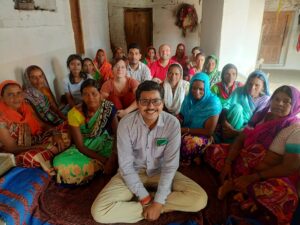
In preparation for source protection activities to commence, AidEnvironment organized and engaged communities in Community Mobilization & Planning which involved holding community meetings to explain why the water source needs protection. Likewise, activities to enhance the capacity of Water User Committees (WUC) were held.
A preliminary assessment to map surrounding land use (gardens, homesteads, etc) and site surveying by the technical team was conducted to mark boundaries and establish a buffer zone, as well as collect accurate, on-site information before designing, installing, or supporting the water system. These are important steps to help reduce risk, and ensure feasibility toward project success.
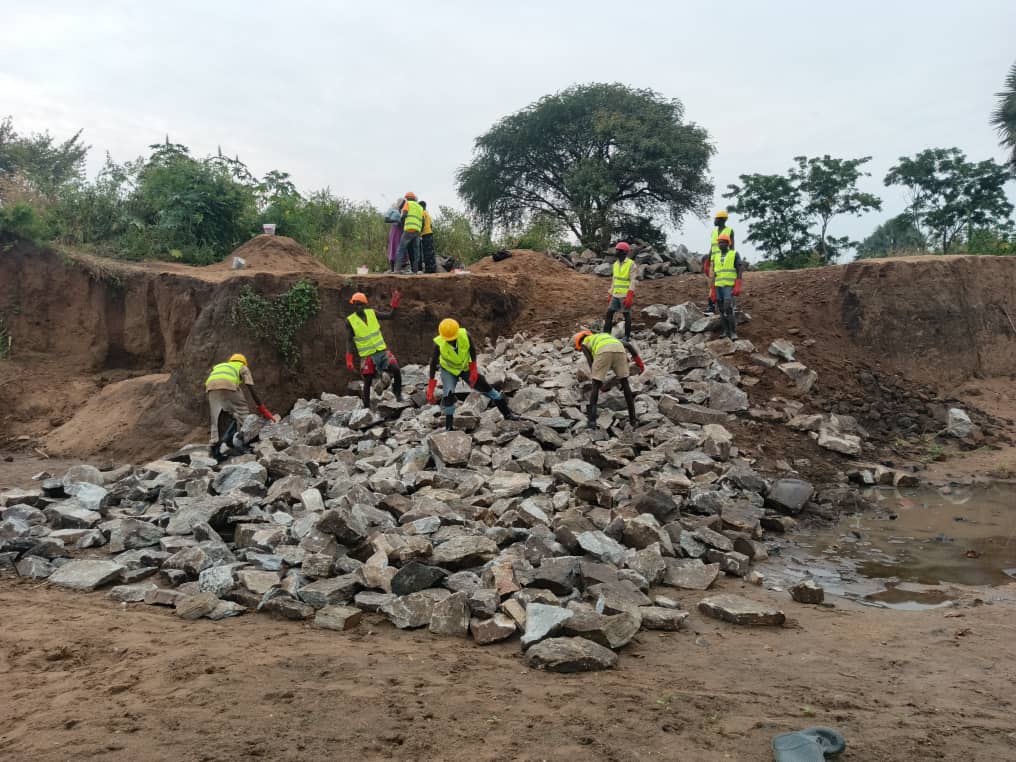
In preparation for construction, materials such as stones, sand, cement, bricks, pipes, mesh, and gravel, were sourced and prepared, alongside the identification of reliable local masons.
In order to provide a holistic intervention, the following aspects were also integrated into the water source protection programme:
Source protection & catchment care: Implementing measures to protect catchments and groundwater recharge zones ensures longterm water quantity and quality (not just point-source protection but broader environmental stewardship).
Hygiene and sanitation integration: Ensuring water supply improvements go hand-in-hand with sanitation, hygiene facilities, and community sensitization helps protect water sources from contamination from latrines, waste, runoff etc.
Stakeholder engagement: Effective water source protection requires cooperation among governments, civil society organizations, community-based organizations, non-governmental organizations, farmers, and local communities, supported by strong policies and continuous monitoring.
Ultimately, protecting water sources is not just an environmental responsibility but a foundational investment in public health, economic stability, and the resilience of future generations.AidEnvironment contacted the Ministry of Water and Environment, Yumbe District Local Government and other partners to participate and include Yangani in their other water-source protection programmes. We continue to engage communities to ensure their involvement and contribution, e.g. labour, local oversight committee, to enhance ownership and sustainability.
Through water source protection, this project contributes to safeguarding human health, preserving ecosystems, and ensuring long-term water security. By preventing contamination at its source through sustainable land-use planning, pollution control, watershed management, and community engagement, there will be a reduction in the need for costly treatment and result in improved maintenance of the natural integrity of the water source.
As part of its Water Supply and Sanitation for Refugee Settlements and Host Communities in Northern Uganda (WatSSUP) Programme, GIZ awarded AidEnvironment a grant to implement targeted interventions focused on protecting the Oxfam-ARC Yangani water supply system in Yumbe District. The refugee settlements and host communities will take the leading role in implementing the interventions. In collaboration with local leaders, […]
AidEnvironment, with support from GIZ, and in collaboration with local authorities, humanitarian partners, and community representatives, convened an Inception Workshop in Yumbe District to launch the Water Source Protection Project for refugee and host communities. The workshop brought together key stakeholders to establish a shared vision for safeguarding water resources in Yumbe district, one of Uganda’s most water-stressed districts in […]
The Ministry of Water and Environment, along with implementation partners and local stakeholders, officially launched the implementation phase of the Irrigation for Climate Resilience Project (ICRP). The launch event, held in Mbarara City, was attended by high-level government officials, representatives from Community Based Organizations, Civil Society groups, and local community leaders. The Government of Uganda with funding from the World […]
Article drafted by Niels Lenderink, Senior Programme Manager A consortium involving Meta Meta Research, CDE at University of Bern (WOCAT), Acacia Water and AidEnvironment, funded by the World Bank, is developing the Water Potential Estimator (WPE). The WPE is the second in the series of online tools developed by the consortium. The first one is the Water Harvesting Explorer (WHE), […]
By Anne Kikundwa, Okot Brian, Lukwago Brian, AidEnvironment East Africa Office. At the core of integrated water resources management (IWRM) is the need for equitable, beneficial and sustainable use of water and environment resources. IWRM has been widely adopted by governments and both national and international organisations. AidEnvironment seeks to further its adoption. To achieve this, AidEnvironment engaged all stakeholders […]
The Uganda Water and Environment Week (UWEWK) is an event organized annually by the Ministry of Water and Environment (MWE) through the Water Resources Institute (WRI). Since its inception in 2018, the event seeks to contribute towards the attainment of sustainable socio economic transformation and achieving the Ugandan National Development Plan and vision 2040. This year, AidEnvironment joined other partners in […]
For the first time, the AidEnvironment team has collated a snapshot of the work we have undertaken across issue areas and geographies. Looking back at 2023, we continued to strengthen and improve our initiatives in the Sector Transformation field by undertaking assessments and strategic development for stakeholders aiming for fairer and more inclusive supply chains. We likewise increased our […]
Article drafted by Kikundwa Anne & Lukwago Brian In Lwakhakha, Uganda, women are the primary users of cookstoves, often bearing the responsibility of securing cooking fuel like wood and charcoal to prepare meals for the family. Most of the households in the Lwakhakha sub-region rely on traditional cookstoves that burn wood and charcoal. However, these fuels are inefficient, costly, and unhealthy. Traditional cooking emits carbon monoxide and other toxic fumes that are harmful to human health, leading to many deaths each year. Women […]
The Government of Indonesia, through East Java Province, and the Government of the Netherlands continue their collaboration in the Welang watershed, East Indonesia. Per a process of co-creation, the organisations aim to facilitate a multi-stakeholder approach to tackle the water challenges in the Welang watershed, identify sustainable solutions and make a significant impact to water safety and water security. This […]
Article drafted by Niels Lenderink, Senior Programme Manager The Water Harvesting Explorer (WHE) has been developed with funding from the World Bank by a consortium of organisations with expertise in small scale water harvesting: Acacia Water, MetaMeta, CDE at University of Bern (WOCAT), IGRAC, IHE Delft Institute for Water Education, Stockholm Resilience Centre, Verdant Earth, Global Water Partnership West-Africa, and […]
Article by Anne Birungi Kikundwa Northern Uganda is a region blessed with abundant rainfall. If properly managed, it has the potential to remove the burden of communities suffering from the lack of access to potable water during the dry season. However, the practice of rainwater harvesting in the region has remained minimal partly due to lack of hard roofs […]
Your dose of sustainable solutions As another quarter comes to a close, our team continues to work with partners around the globe collecting data, developing strategies for sustainable sector transformation, and putting these strategies into action on the ground. From Indonesia to Uganda, we’re excited to share the latest updates in our September Newsletter. If you are working on similar […]
This past August, the AidEnvironment team returned to India to visit areas under the Green Transformation Project (GTP) in Madhya Pradesh and Jharkhand. Junior expert on land and water management, Marina Gutiérrez, together with Ruben Borges, an external consultant for the GTP project who specializes in soil fertility, conducted a two-week scoping mission, visiting different project areas in which regenerative […]
AidEnvironment Senior Programme Manager Niels Lenderink, along with Junior Expert Jyoti Mishra, organized a field visit and meeting under the Green Transformation Pathways (GTP) project on July 6-7, 2022 in Ranchi, Jharkhand State, India. The goal of the meeting, which had participants from partner organizations, Professional Assistance For Development Action (PRADAN), Foundation for Ecological Security (FES), and the Dutch MetaMeta, […]
Our new website is here! The AidEnvironment team is thrilled to share that our updated website is now live. We have a new look to reflect how our work has evolved. But our mission remains the same: to work together with our partners to protect and restore ecosystems and improve livelihoods. You can read more about it here. Sharing our experiences […]
AidEnvironment launches its new website along with a new look, including a bright new color palette and a new logo. These visual reminders reflect how AidEnvironment continues to grow and innovate while remaining committed to our vision to build a sustainable, collaborative, and inclusive world with our partners.
Climate change has exerted substantial effects on water cycles worldwide by changing the seasonal pattern of water resources. Agago District in Uganda is particularly affected, where water flows are expected to exceed socio-ecological thresholds for hydrological cycles. This impacts ecosystems and people’s livelihoods and well-being. Coupled with environmental degradation due to flooding, deforestation and excessive tree cutting, crop and cattle […]
Recently, Aidenvironment got a new program approved by the IKEA Foundation. The program focuses on regenerative agriculture and is called Green Transformation. The program will be implemented in Jharkhand and Madhya Pradesh in India, together with three other partners: PRADAN, FES and MetaMeta Research. Currently, these areas in India face challenges in degradation of ecology, low agricultural returns, and increasing rural distress; all complicated by climate change. To promote […]
During SIWI World Water Week, WASH Alliance International member Aidenvironment, under its brand RAIN, and Wetlands International, Simavi, the African Medical and Research Foundation (AMREF), and IRC organized a session on how Integrated Water Resources Management (IWRM) can make WASH interventions more resilient to climate change impacts. During this session, RAIN showed a video about a wetland in Northern Uganda which has […]
The LASER-PULSE East Africa Water Security project, of which Aidenvironment is a member of the implementing team, held its first stakeholder meeting. It was attended by 72 participants, ranging from water resources managers, NGO personnel, industry representatives, and policymakers to academics and students of water management. The participants provided valuable insights and suggestions on data, policy, and stakeholder engagement: The quality […]
Northern Uganda experiences floods and droughts, impacting water supply, hygiene and health, and livelihoods. These floods and droughts seem to become more extreme, possibly linked to climate change. In the framework of the WASH SDG programme, RAIN (a brand of Aidenvironment) together with AMREF Flying Doctors and Simavi (all members of the WASH Alliance International), has piloted a solution to this problem in 2018. In […]
Through the Green Future Farming Project, AidEnvironment is piloting the use of bamboo as the main structural material for rainwater harvesting tanks in coffee-growing communities in Uganda. The lower costs will enable farmers to collect more rainwater and prevent soil erosion. The Sebei region on the slopes of Mount Elgon produces some of the best specialty Arabica coffee in Uganda. […]
The western Sahel is drying up, degrading and arable land is getting scarce. Yet, every year, water from arid upstream lands of the western Sahel causes downstream floods. In other areas large dams leave people downstream without water. This situation raises several questions, where are these areas with excess water? Where and during what period of the year should water […]
Recently a consortium led by Aidenvironment won a World Bank contract for a study on operationalizing small-scale water storage initiatives with the aim of providing water security in Western Sahel. The one-year study will deliver implementation guidelines for good practices. It is known that small-scale watershed interventions can deliver significant benefits in local water resources availability for water supply, irrigation, […]