Aceh Tamiang inundated with floods from Cyclone Senyar illustrates link to deforestation
Article by Erliza Arthalina, AidEnvironment intern
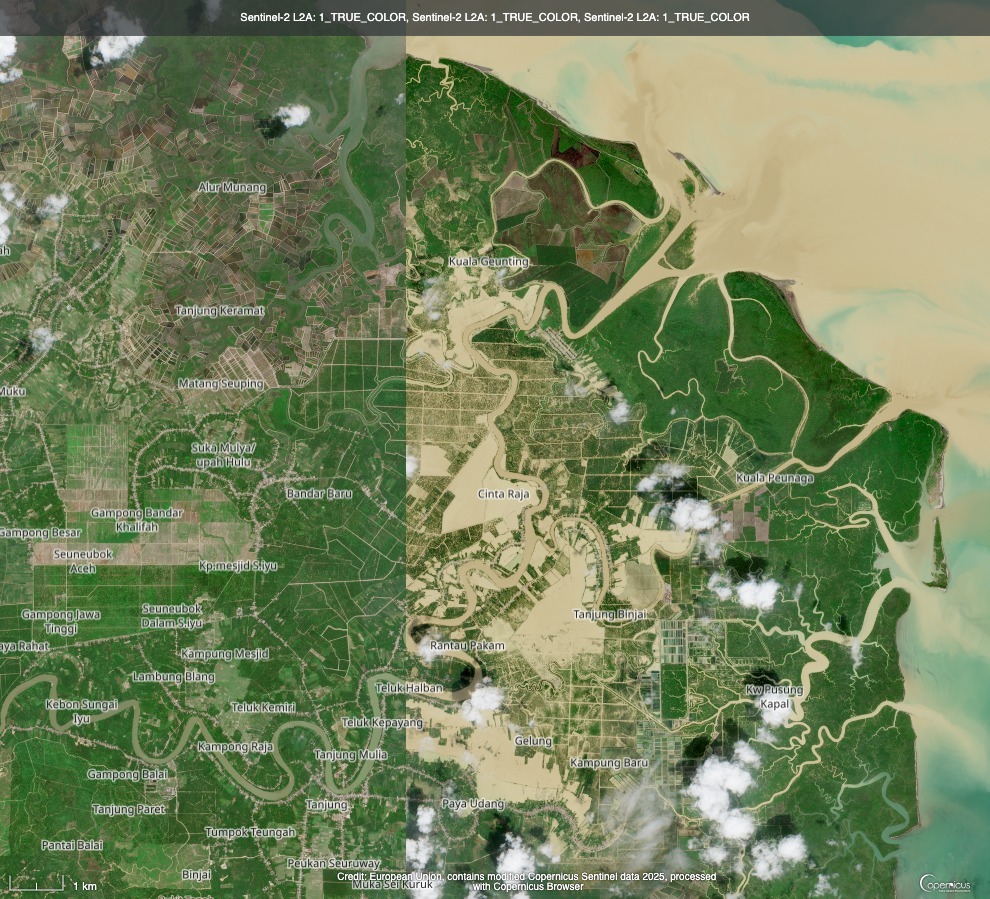
Looking back at the Sumatran floods nearly three months ago, one of the districts most severely affected was Aceh Tamiang, which spans 2,216.16 km² (1). Located on the eastern coast of Aceh Province and bordering the Malacca Strait, the district is dominated by palm oil plantations, leaving only 576 km² of forest, less than a quarter of its total land area (2). According to Global Forest Watch, between 2002 and 2024 Aceh Tamiang lost 6.8 kha of humid primary forest and 57 kha of total tree cover, resulting in an estimated 25 Mt of CO₂e emissions (3). The extensive forest clearance and conversion into monoculture landscapes have significantly altered local hydrological dynamics. These environmental changes intensified the impacts of La Niña and Cyclone Senyar by reducing the highlands’ capacity to retain water, thereby accelerating surface runoff and amplifying river discharge during heavy rainfall events (4). The resulting floods devastated vast lowland areas, including the provincial capital of Banda Aceh, leading to 1,204 confirmed fatalities, with 101 deaths occurring in Aceh Tamiang alone (data as of 10 February 2026) (5). Satellite imagery analysis between 23 August and 1 December 2025 further illustrates how floodwaters inundated formerly productive agricultural zones, reshaping local topography and creating new river channels that swept through numerous villages.
Based on satellite imagery from the Nusantara Atlas, the largest palm oil concession in Aceh Tamiang belongs to Perkebunan Nusantara I (PTPN I), covering approximately 5,557 hectares across three estates (6). As a state-owned enterprise, PTPN I reportedly held three cultivation rights (HGUs) that became inactive in 2025, with one having expired in 2024 and two pending renewal (7). Although this concession is not directly associated with the recent flooding, the revocation of its HGU licenses indicates ongoing issues in land tenure enforcement and administrative follow-up (8).
The Ministry of Environment and Forestry has also identified several companies allegedly contributing to flood risk in Sumatra, including PT Tualang Raya in the Jambo Aye watershed, PT Wajar Corpora in the Tamiang watershed, and PT Tusam Hutani Lestari (9). PT Wajar Corpora, which is a regionally owned enterprise under the Aceh Timur government, had its license revoked in 2022, yet appears to have been revoked again in 2025, when in fact it merely needs an evaluation instead of re-revocation (10, 9). Collectively, these patterns reveal that national and subnational actors have been directly implicated in the governance failures underpinning the flood disaster in Aceh Tamiang.
Public debate over these governance lapses intensified after the resurgence of the Indonesian President’s statement in 2024, asserting that deforestation need not be feared. There was much backlash when flooding occurred in Sumatra, followed by a series of floods that hit Java (11, 12). Despite the ongoing recovery from these disasters, the President subsequently announced plans to accelerate palm oil expansion in Papua (13). Papua already hosts about 1.33 million hectares of palm oil plantations, with the majority of land concentrated in a few large conglomerate groups (14). More recently, the President declared the government’s intention to revoke 28 illegal company licenses allegedly contributing to Sumatra’s flooding (15). However, this move has drawn criticism, as many of these concessions are expected to be transferred to Agrinas, a state owned enterprise that took over palm oil plantations (16). In practice, such measures suggest that environmental enforcement remains largely a formality, with limited commitment to ecological restoration.
Without restoring deforested plantation areas back into forest ecosystems, national flood prevention efforts risk remaining largely symbolic. These developments underscore that Indonesia’s recurring flood disasters are not isolated natural phenomena but are tightly linked to systemic deforestation.
Sources:
(1) Aceh Marine and Fisheries Service. N.d. Profile of the Aceh Tamiang Region Online, https://uptdpkkpd.acehprov.go.id/halaman/profil-kawasan-aceh-tamiang, viewed in December 2025.
(2) Nusantara Atlas. n.d. Summary of Aceh Tamiang in the Administrative Boundary Online https://map.nusantara-atlas.org/, viewed in December 2025.
(3) Global Forest Watch. N.d. Summary of Aceh Tamiang, Aceh, Indonesia. https://www.globalforestwatch.org/dashboards/country/IDN/1/7/?map=eyJjYW5Cb3VuZCI6dHJ1ZX0%3D, viewed in December 2025.
(4) TDMRC. 2025. Beyond the Equator: How Cyclone Senyar Redrew the Landscape of Aceh.https://tdmrc.usk.ac.id/2025/12/30/beyond-the-equator-how-cyclone-senyar-redrew-the-landscape-of-aceh/, viewed in February 2025.
(5) BNPB (2025, February) BANSOR SUMATERA 2026 Geospatial Dashboard: Flood and Landslide Monitoring. Pusdatinkom BNPB. Accessed February 10, 2026. https://gis.bnpb.go.id/BANSORSUMATERA2025/
(6) Nusantara Atlas. n.d. Oil Palm Concession: Perkebunan Nusantara Online, https://map.nusantara-atlas.org/, viewed in February 2026.
(7) Hendra Vramenia. 2025. 3 Perusahaan Perkebunan Kelapa Sawit di Aceh Tamiang Beroperasi Tanpa HGU . https://kabartamiang.com/news/3-perusahaan-perkebunan-kelapa-sawit-di-aceh-tamiang-beroperasi-tanpa-hgu/index.html
(8) Indonesia Media Center. 2026. Sikap Tegas Pemkab Aceh Tamiang: Beri Deadline Perusahaan Sawit, Lahan Huntap Korban Banjir Adalah Harga Mati! https://www.indonesiamediacenter.com/2026/02/sikap-tegas-pemkab-aceh-tamiang-beri.html
(9) WALHI. (2026, Januari). Pemulihan Sumatra Tidak Boleh Berhenti di Pencabutan 28 Perizinan Berusaha!
(10) Analisa Daily. 2024. BPKD Aceh Timur Benarkan Perusahaan Wajar Corpora Tidak Lagi Bayar PAD.https://analisadaily.com/berita/baca/2024/06/24/1053412/bpkd-aceh-timur-benarkan-perusahaan-wajar-corpora-tidak-lagi-bayar-pad/
(11) Hans Nicholas Jong. 2025. Indonesian president says palm oil expansion won’t deforest because ‘oil palms have leaves’. Online.https://news.mongabay.com/2025/01/indonesian-president-says-palm-oil-expansion-wont-deforest-because-oil-palms-have-leaves/, viewed in December 2025
(12) WALHI. (2026, February). Bencana Ekologis di Pulau Jawa Kian Mengarah pada Kondisi Permanen. Accessed February 10, 2026
https://www.walhi.or.id/bencana-ekologis-di-pulau-jawa-kian-mengarah-pada-kondisi-permanen
(13) BBC News Indonesia. 2025. Prabowo ingin tambah lahan sawit di Papua – Siapa yang akan paling dirugikan akibat kebijakan ini? https://www.bbc.com/indonesia/articles/crrk14e41ddo
(14) Yayasan Bentala Pusaka. 2025. Perusahaan Hisap Tong Pung Darah https://pusaka.or.id/riset_investigation/perusahaan-hisap-tong-pung-darah/
(15) Kompas. (2026, January). Presiden Prabowo Cabut Izin 28 Perusahaan Terkait Banjir dan Longsor di Sumatera.
(16 Sarjan Lahay. (2025, April). Menyoal Kebun Sawit Ilegal Beralih ke Agrinas Palma https://mongabay.co.id/2025/04/11/menyoal-kebun-sawit-ilegal-beralih-ke-agrinas-palma/
Source: Copernicus Sentinel data [left: 23 August 2025, right: 1 December 2025]