Compliance Checker: Brazil Cocoa Sustainability Risk Profile
A Compliance Checker analysis by AidEnvironment identifies sustainability risks in Brazil’s rapidly expanding cocoa sector, raising questions about traceability, indirect sourcing and due diligence by major cocoa traders and chocolate companies.
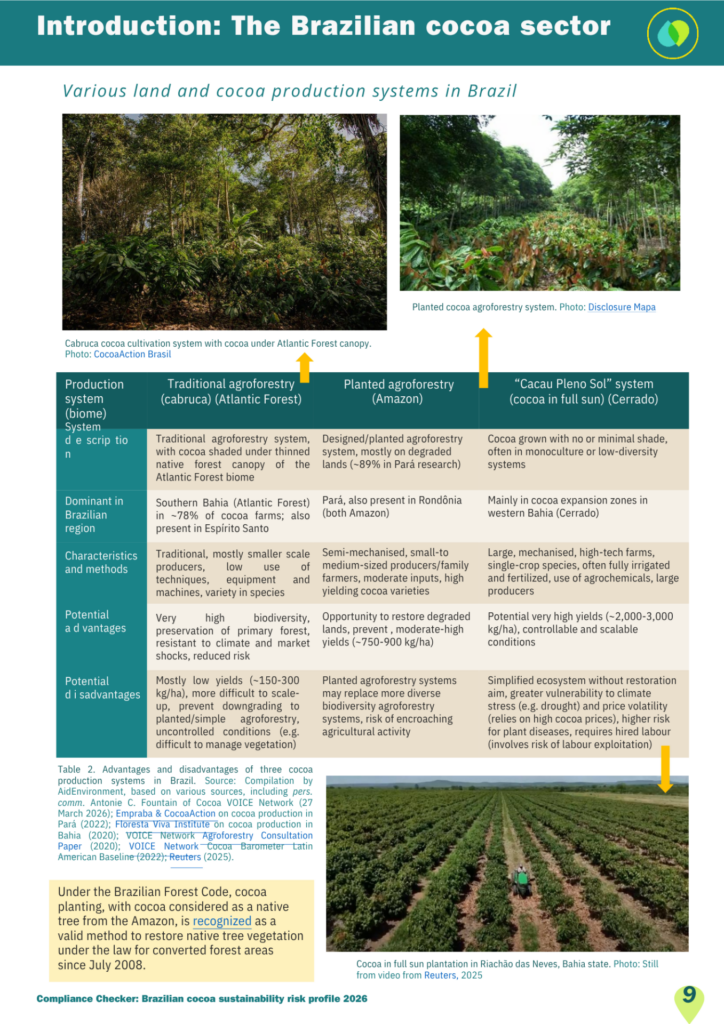
Brazilian cocoa is increasingly promoted as a sustainable growth opportunity: a crop that can help restore degraded land, protect forests, and position Brazil as a responsible cocoa origin for global markets. The report acknowledges that cocoa production in Brazil generally appears less exposed to direct deforestation risks than soy or cattle, and that national initiatives such as Inova Cacau 2030 seek to expand cocoa on degraded pastureland while improving production standards.
However, the report identified cases where cocoa farms or cocoa-linked properties are associated with recent forest clearance, environmental fines and embargoes, land-title irregularities, overlaps with Indigenous territories, and labour conditions analogous to slavery. Some of the forest clearance identified took place after the EUDR cut-off date and may therefore create compliance risks if cocoa from these areas enters the EU market from January 2027.
Company responses to AidEnvironment’s findings on nine Brazilian cocoa cases with social environmental violations and risks shared in May 2026 revealed uneven levels of due diligence and mitigation actions. Barry Callebaut provided the most detailed response and reported supplier suspension or pending sourcing status in several cases, both for direct and indirect suppliers.
“These cases show that Brazilian cocoa cannot be treated as automatically low risk,” said Sarah Drost, Senior Researcher Deforestation-free Supply Chains at AidEnvironment. While Brazil has strong potential to grow cocoa on degraded land and through agroforestry systems, the potential will only be credible “if companies can prove where their cocoa comes from, screen direct and indirect suppliers, and act transparently when non-compliance risks are found.”
Excerpt from the report